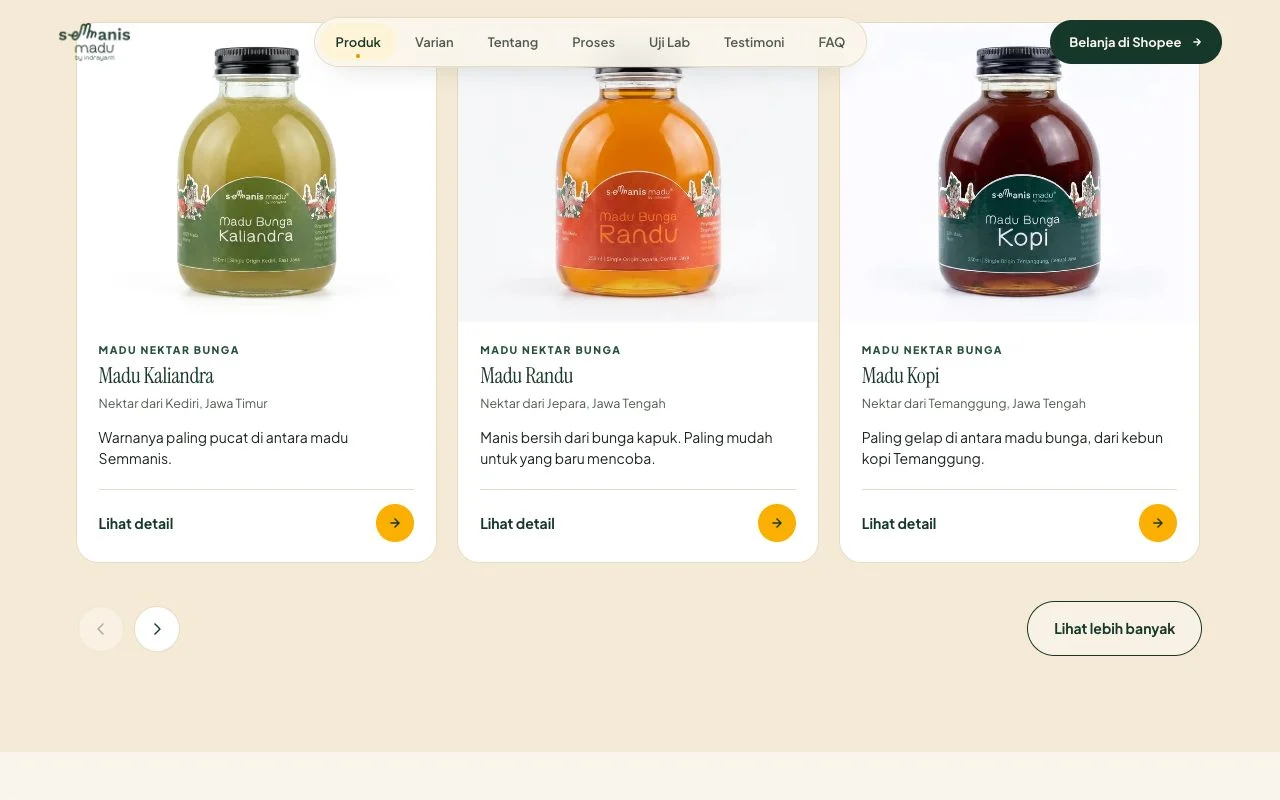
Semmanis Madu sells raw honey, bee pollen and royal jelly from the bee farm of Pak Siyamto, the owner's father. The colonies are moved from forest to forest with the flowering seasons, and every batch is harvested from one nectar source. The brand already sold on Shopee and posted on Instagram, but it had no home of its own on the web. The site is live at semmanismadu.com.
At a Glance
- Client: Semmanis Madu by Indrayanti, a family honey business with its own bee farm
- Brief: build the brand and its digital presence, for an owner who does not want to maintain a website
- Delivered: concept and layout, a scrollytelling landing page, a product showcase tied to Shopee, WhatsApp enquiries that show where a lead came from, a CMS, an education blog, SEO groundwork and a plan for AI search
- Stack: EmDash CMS on Cloudflare Workers, Free plan, custom domain
- My role: consultation, concept, information architecture, design direction, build, SEO and launch. The content itself (products, facts, story) came from the client.
The Brief Changed After the First Conversation
The request was a landing page for branding, close to a company profile. After talking it through, I suggested something more useful for a brand that already sells online: a product showcase that matches the Shopee store item for item. A company profile tells people who you are; a showcase also tells them what to buy and where, then hands them to the store they already trust.
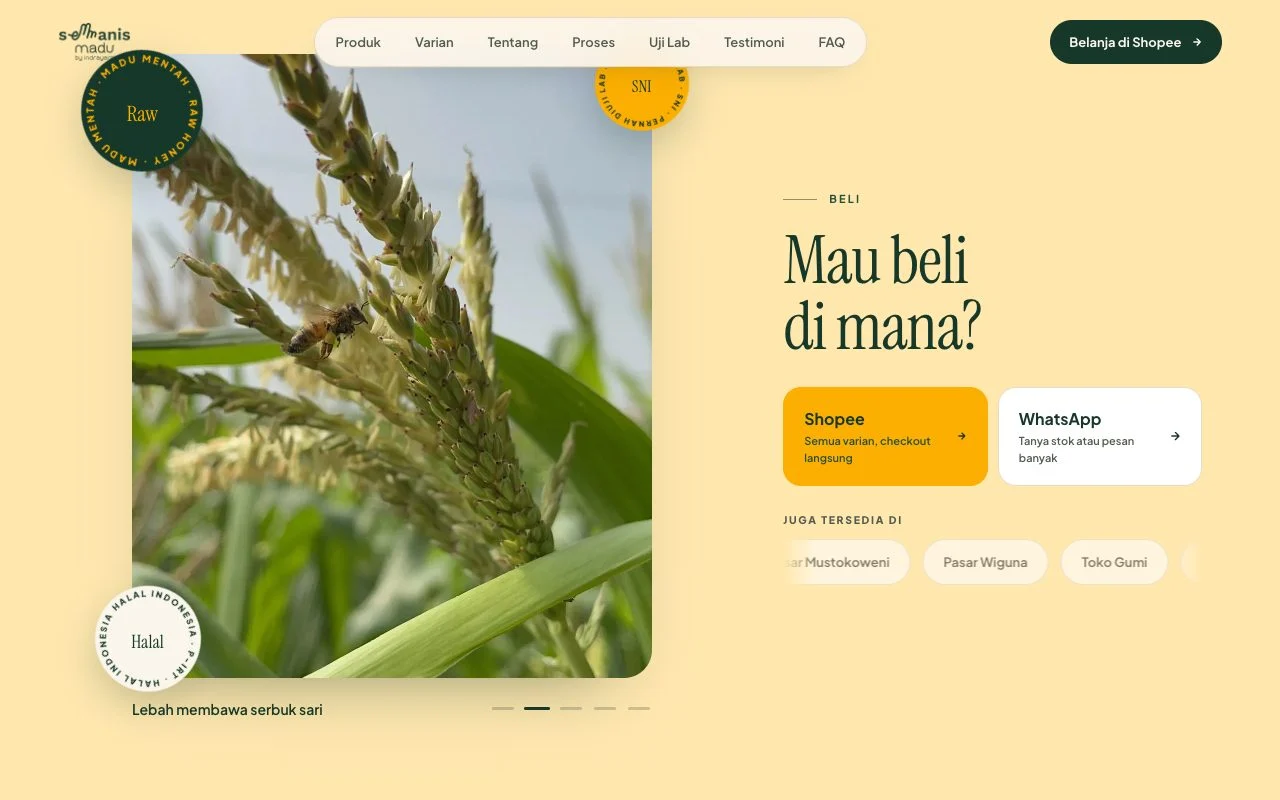
- Every product on the site links to its own Shopee listing, so the site never has to handle payment, stock or shipping
- Anyone who wants to ask first can chat on WhatsApp instead
- The brand story sits around the products, so a visitor learns why this honey is different before choosing one
A Minimal Page That Tells the Story as You Scroll
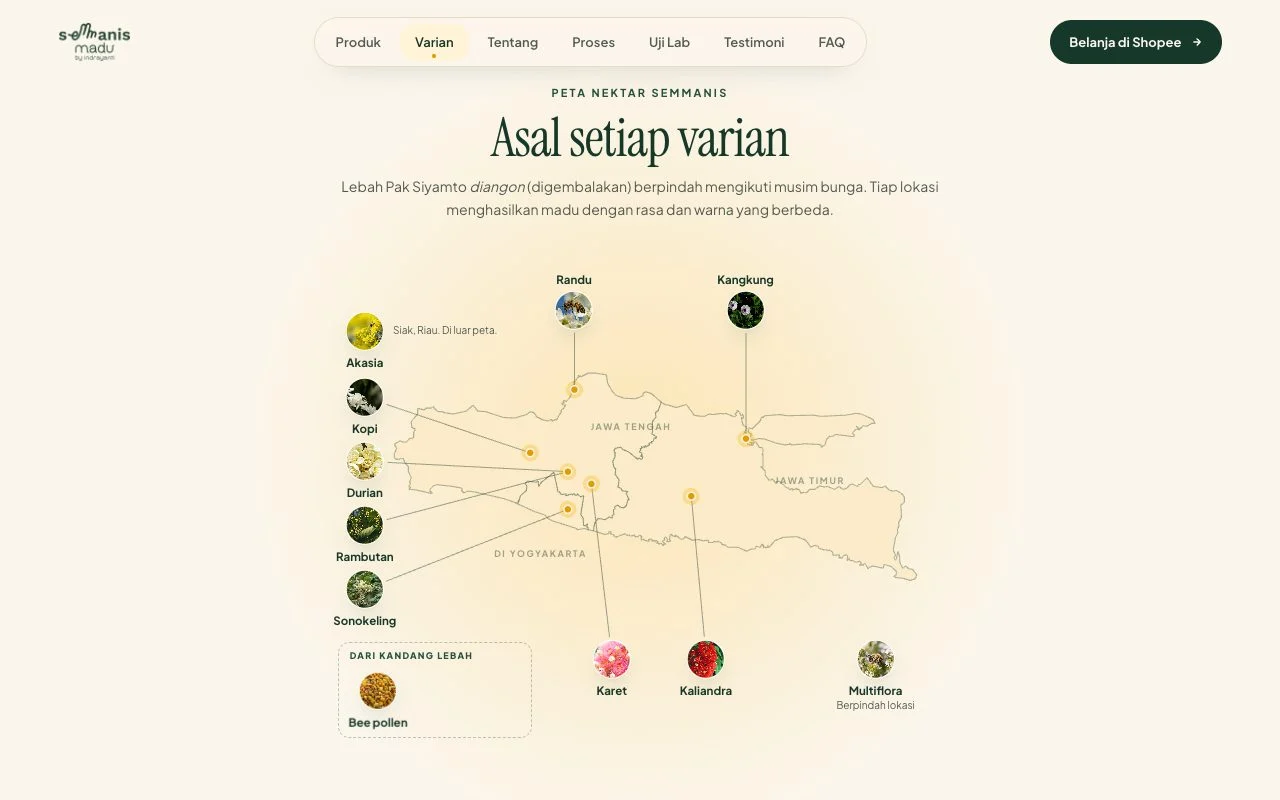
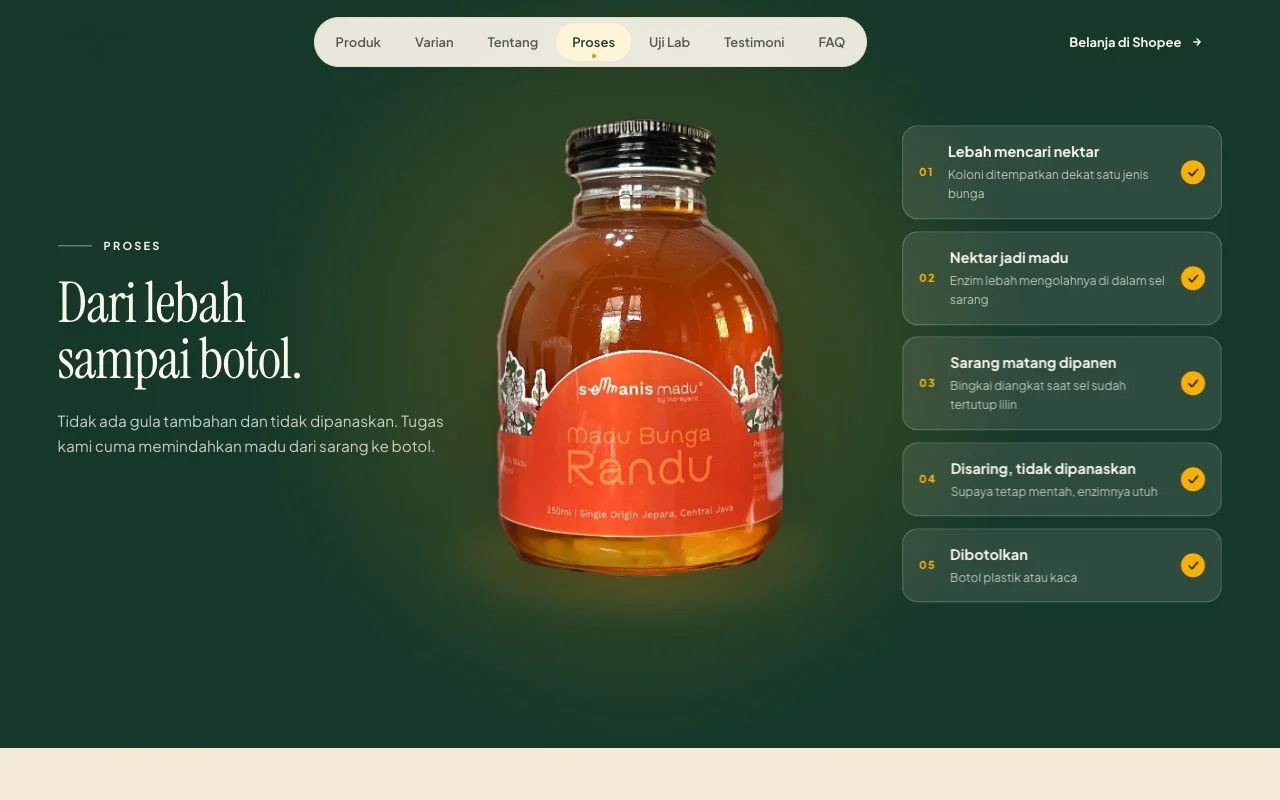
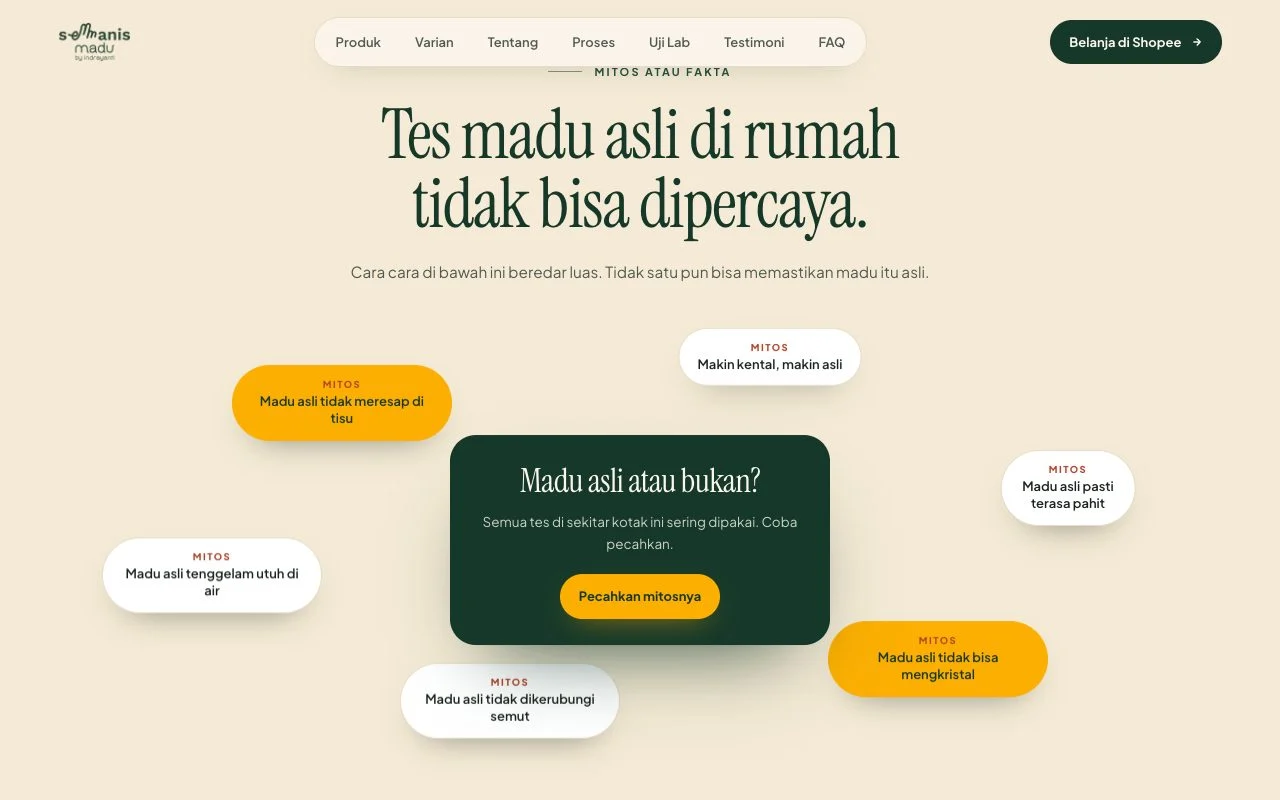
Honey is hard to judge from a photo, so the page has to earn trust. I mapped the layout as one long scroll that tells the story in order: where each honey comes from, how it is harvested, the myths buyers worry about, the lab test, what other buyers said, and where to buy. Scrollytelling keeps each idea on screen long enough to land while the page itself stays minimal.
- A nectar map that shows where each variant comes from, from Jepara to Siak
- The harvest process told step by step as the bottle stays in view
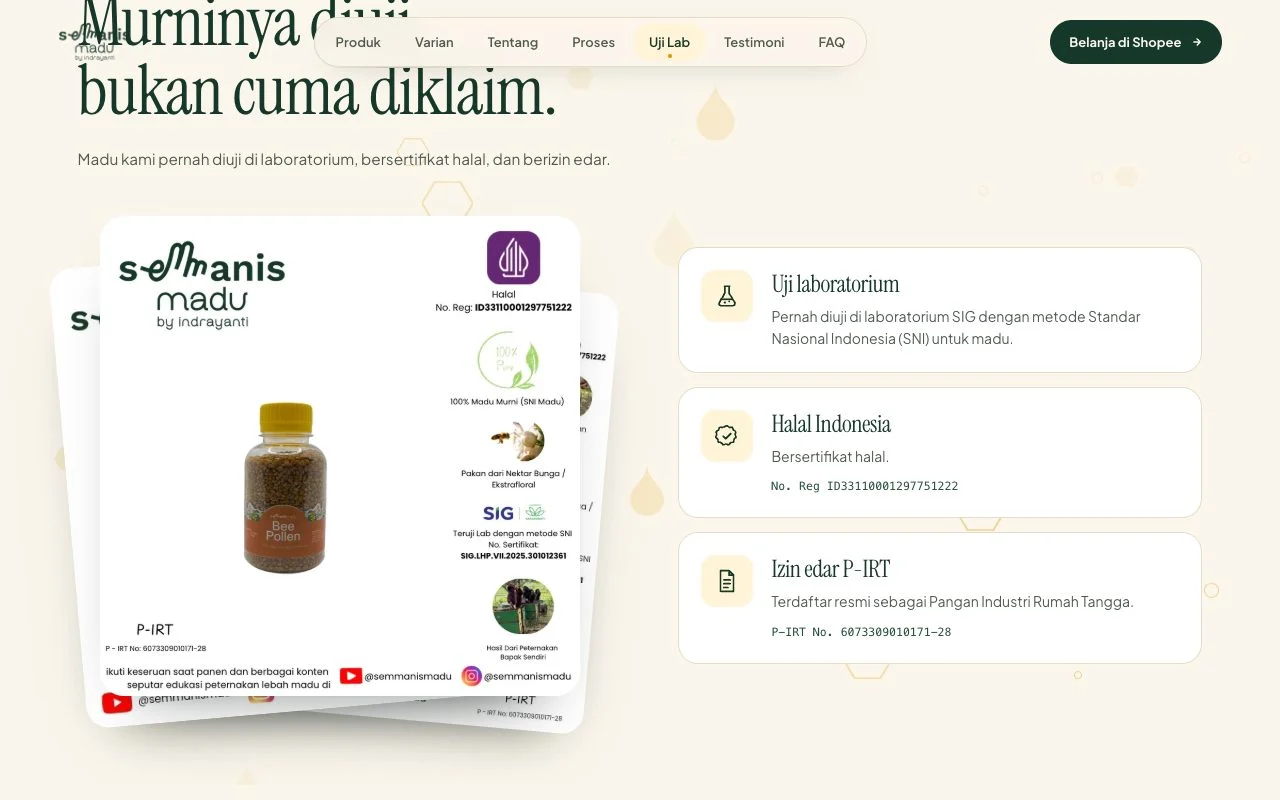
- Common honey myths, set against the lab test and the Halal and P-IRT registrations
- Buyer reviews pulled as written from Shopee and Threads
Content From the Client, Concept and Delivery From Me
The products, facts and story came from the client: the variants and their origins, the certificates, the lab results and the family history. My part was to turn that material into a concept, a structure and a working site, and to write it in a voice that sounds like a family business rather than a supplement ad. Facts that were still unconfirmed stayed marked as drafts until the client checked them.
A CMS the Owner Can Run Alone
The client expected low maintenance and is not familiar with websites, so the platform had to be light, easy and cheap. I built it on EmDash, a CMS that runs on Cloudflare Workers:
- Light: the pages are rendered at the edge, close to visitors in Indonesia
- Easy: products, variants, reviews, FAQ, gallery, page copy and blog posts are all edited from one admin panel, without touching code
- Cheap: it runs on Cloudflare's free plan with the client's own domain. To fit under the free plan's size limit, I trimmed the admin's unused language files so the whole app stays below 3 MB compressed.
Every Enquiry Says Where It Came From
A small shop rarely knows which channel brought a buyer. Every WhatsApp button on the site opens a chat with a message already written, and that message names the product the visitor was looking at, for example: "Halo Semmanis Madu, saya lihat website-nya dan mau tanya soal madu Randu." When a chat starts with that line, the owner knows it came from the website and which product sparked it, with no extra tool to learn.
On the analytics side, every click on a Shopee or WhatsApp button is recorded in Google Analytics 4 with two details: where on the page it was clicked and where it was going. Together they show which sections actually move people to buy.
A Blog for the Questions Buyers Ask
The brand wants to be known as the honey people trust because they understand it. So the site has an education blog that answers the questions buyers type into search before they buy. It launched with five articles:
- What raw honey is, and how it differs from regular honey
- How to tell real honey from fake, and why a lab test matters
- How to store honey, and whether it needs the fridge
- Types of honey by nectar: randu, kaliandra, coffee, rambutan and durian
- Crystallised honey: still safe, and how to make it runny again
SEO Groundwork, and a Plan for AI Search
What is in place
- A title and description for every page, an Open Graph image for sharing, and a sitemap that lists every page
- Structured data that tells search engines who the business is (Organization), what the site is (WebSite) and the answers in the FAQ (FAQPage)
- Search Console verified through the domain, and Google Analytics 4 with the click events above
- A robots.txt that welcomes search engines and AI search crawlers and keeps them out of the admin
- Per-article SEO fields, author, categories and tags, all editable in the CMS
What comes next
AI search tools such as ChatGPT, Perplexity and Google's AI Overviews quote pages that give a clear, checkable answer. The plan for Semmanis is to write each answer so it can be quoted on its own, keep the brand's facts identical across the site, Shopee, Instagram and Threads, and grow the reviews and lab evidence that back them up. The content strategy behind it is being worked out now.
Speed: From 50 to 97 on Mobile
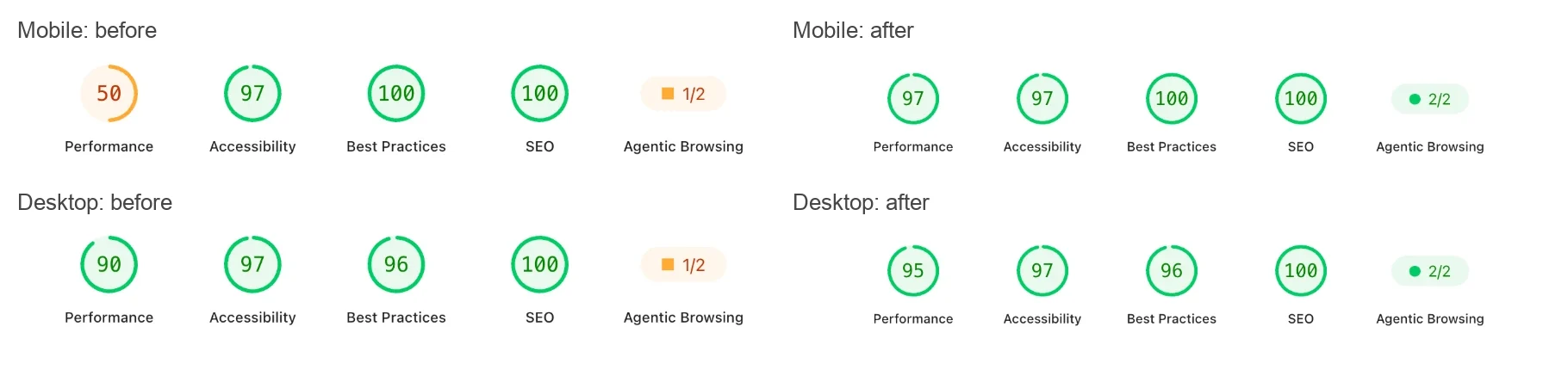
The first PageSpeed Insights test of the live site scored 50 for performance on mobile. I rendered the hero text on the server instead of in the browser, loaded the fonts without blocking the page, matched the fallback fonts to the real ones so nothing jumps, resized the images, and cached the pages at the edge. The same test on the same day (10 November 2026) then scored 97 on mobile and 95 on desktop. Agentic Browsing, the new check for how well AI agents can read a page, went from 1 of 2 to 2 of 2.
What I Would Show a Client From This
- Start from what the business already has. Here it was a working Shopee store, so the site sends buyers there instead of rebuilding checkout.
- Pick the platform for the person who will run it, not for the developer
- Make every lead traceable from the first day, even without a CRM
- Treat speed, structure and crawler access as part of the build, not a later SEO project