Since February 2025 I have looked after the website of a university research institution in Indonesia as a freelance web administrator. The site publishes research articles, case studies and reports in Indonesian and English. The institution is not named here; the figures come from its own Google Analytics 4 and Search Console.
At a Glance
- Organic search sessions up 16% year over year (February to September 2026 against the same months of 2025), and 28% in March to May
- Organic search held between about 1,900 and 3,100 sessions every month for 20 months, peaking at 3,054 in August 2026
- Clicks from Google rose from 66 to 84 a day between July and November 2025
- One research article published in December 2025 became the site's most-seen page in search: 142,000+ impressions at an average position of 5.2
Scope of Work
- Keyword research around the topics the institution publishes on
- Topic clusters that group related publications under shared themes
- Site speed: image compression and removal of plugins the site no longer used
- Article structure: a clear heading hierarchy in long research articles
- Meta titles and descriptions written around what readers actually search for
- Internal links between related publications
- Periodic speed and security checks
Challenge
A research site is written for readers who already know the topic. Titles follow academic convention, long articles run as one block of text, and years of publishing leave plugins and heavy images behind. None of that stops a paper from being good, but it makes it harder for search engines to understand what each page answers, and slower for a reader on a phone.
Approach
The work was steady rather than dramatic: lighter pages first, then structure. Images were compressed and unused plugins removed. Long articles got headings that follow the argument, so both readers and search engines can see the parts. Keyword research showed which questions people actually search around each research topic, and topic clusters grouped related publications so each theme has a clear set of pages. Meta titles and descriptions were rewritten around those questions, and publications in the same cluster were linked to each other so a reader finding one paper can reach the next.
Result
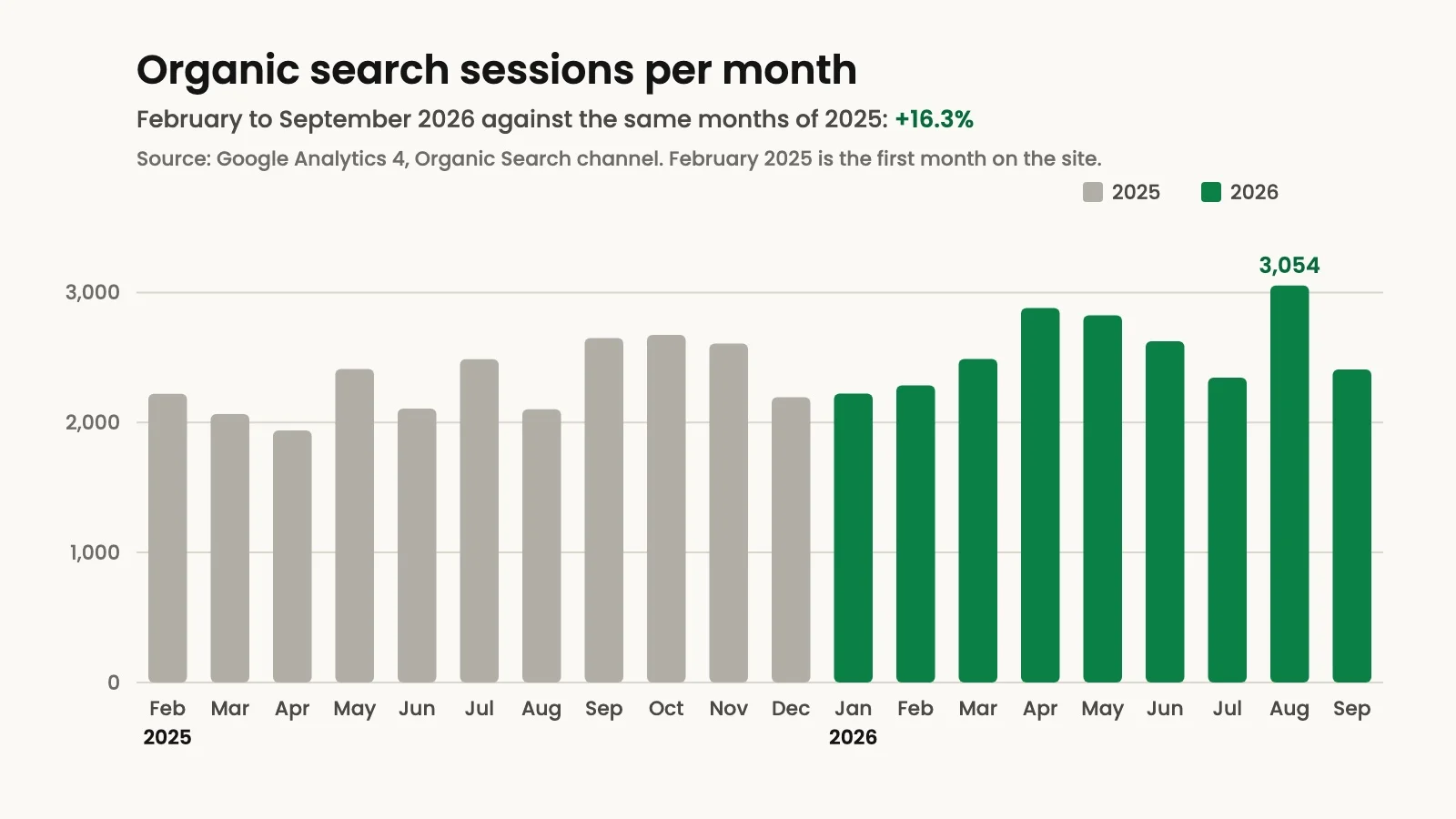
Over the period I have handled the site, organic search grew 16% year over year and stayed steady month to month, with a peak of 3,054 sessions in August 2026. Research traffic also depends on what the team publishes and promotes, so I read these as the result of the content and the site working together.
A note on measurement: I report sessions and clicks rather than average position. In September 2025 Google stopped returning 100 results per query to rank trackers, which removed many deep impressions from Search Console and made average position look better on most sites without any real change in rankings (Search Engine Land). This site's average position jumped at exactly that time, so it is left out.
Tools: WordPress, Google Search Console, Google Analytics 4, PageSpeed Insights.